Plant details
| Altezza a maturità | |
|---|---|
| Crescita | Moderate, Slow |
| Esposizione | |
| Fogliame | Deciduous |
| Manutenzione | |
| Resistenze | |
| Portamento | |
| Terreno | Fertile, Fresh, Sandy, Well-drained |
| Uso consigliato | Large areas/parks |
Fill out the form with your request, and we will get back to you as soon as possible.
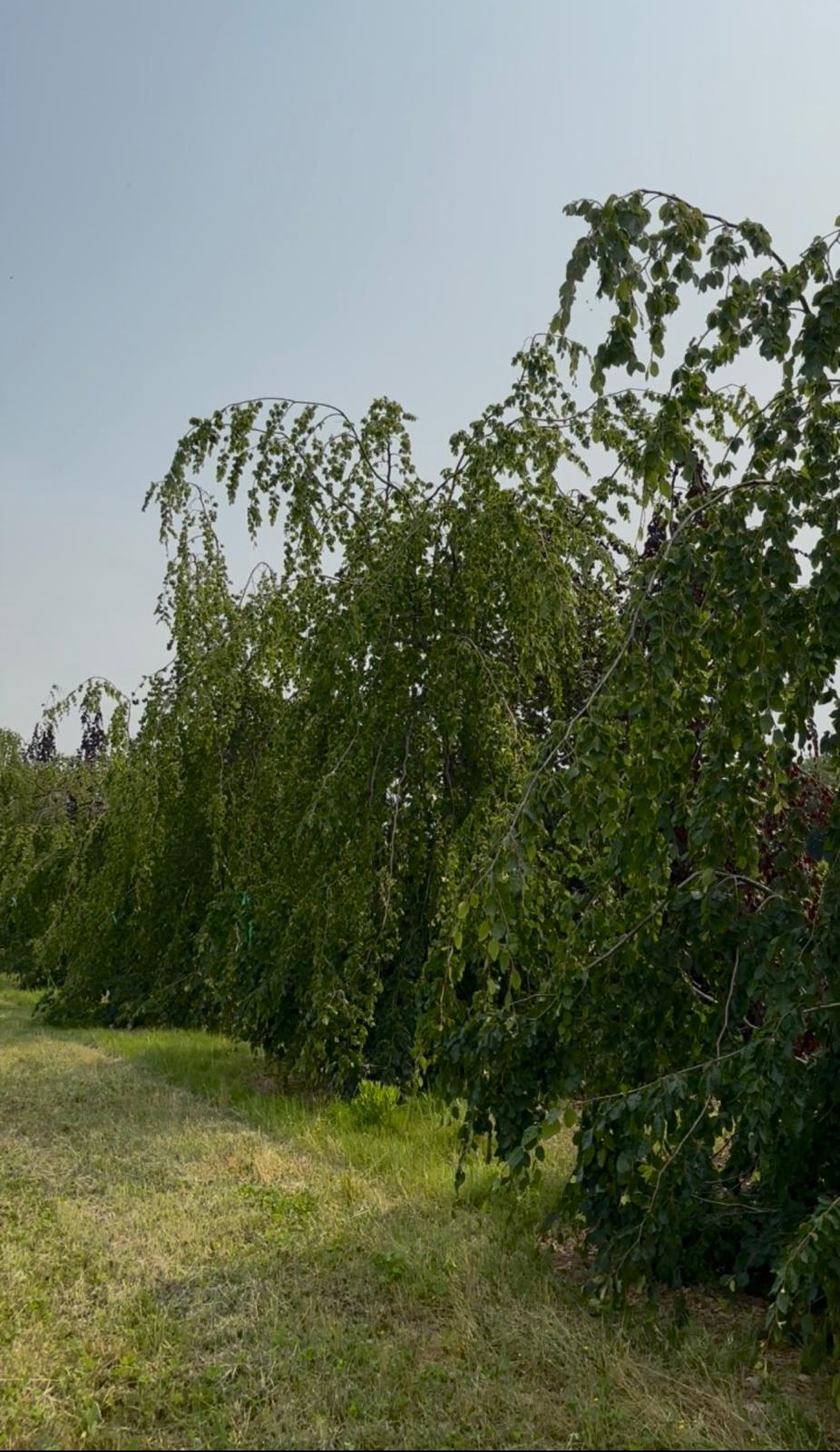
Fagus sylvatica ‘Pendula’ is an ornamental variety with a strong visual impact, distinguished from the common beech by its natural weeping habit, with long, slender, and flexible branches that droop vertically, often reaching the ground.
In nature, the plant tends to develop a wide, low, and very expansive canopy, often with branches starting close to the ground.
However, if trained from a young age with a central stake, it can form a vertical main trunk from which drooping branches descend, creating an umbrella or fountain-shaped canopy.
The leaves are deciduous, ovate-elliptical, with a slightly wavy edge, smooth and shiny surface. In spring and summer, they have a bright, vibrant green color, while in autumn, they transform into spectacular shades of gold, bronze, and copper, providing a strong visual impact.
The plant sheds its leaves in winter but remains decorative due to its smooth gray bark and elegant branching structure, highly appreciated in gardens. The flowers, inconspicuous, appear in April-May; they are monoecious and give way to the beech nuts, small woody fruits contained in spiny husks.
Fagus sylvatica ‘Pendula’ has a slow to moderate growth rate, with limited annual increments. It prefers fertile, cool, and well-drained soils, with a sunny or partially shaded exposure.
It is cold-resistant (down to -20/-25°C), but it is sensitive to hot and dry climates, windy exposures, and polluted urban environments.
Fagus sylvatica ‘Pendula’ finds its ideal location as a solitary specimen in parks, historic gardens, period villas, and formal green spaces, where it can develop its free and expressive shape. It is particularly suitable for prestigious landscaping projects, where a strong, evocative, and timeless architectural presence is sought.
→ Also discover Fagus sylvatica ‘Dawyck Purple’, a variety with a columnar habit and deep purple foliage.


Fill out the form below and we’ll get back to you within 24 hours.