Categories Fruit's tree, Shrubs

Related products
-
 Shrubs
Acer palmatum ‘Fireglow’
-
 Shrubs
Abelia grandiflora
-
 Shrubs
Ilex ‘Nellie R. Stevens’
-
 Shrubs
Camelia Japonica
Plant details
| Altezza a maturità | |
|---|---|
| Crescita | Moderate |
| Fogliame | Deciduous |
| Esposizione | |
| Manutenzione | |
| Resistenze | |
| Periodo fioritura | |
| Portamento | |
| Terreno | Calcareous, Poor, Well-drained |
| Frutti | Autumn, Winter |
Fill out the form with your request, and we will get back to you as soon as possible.
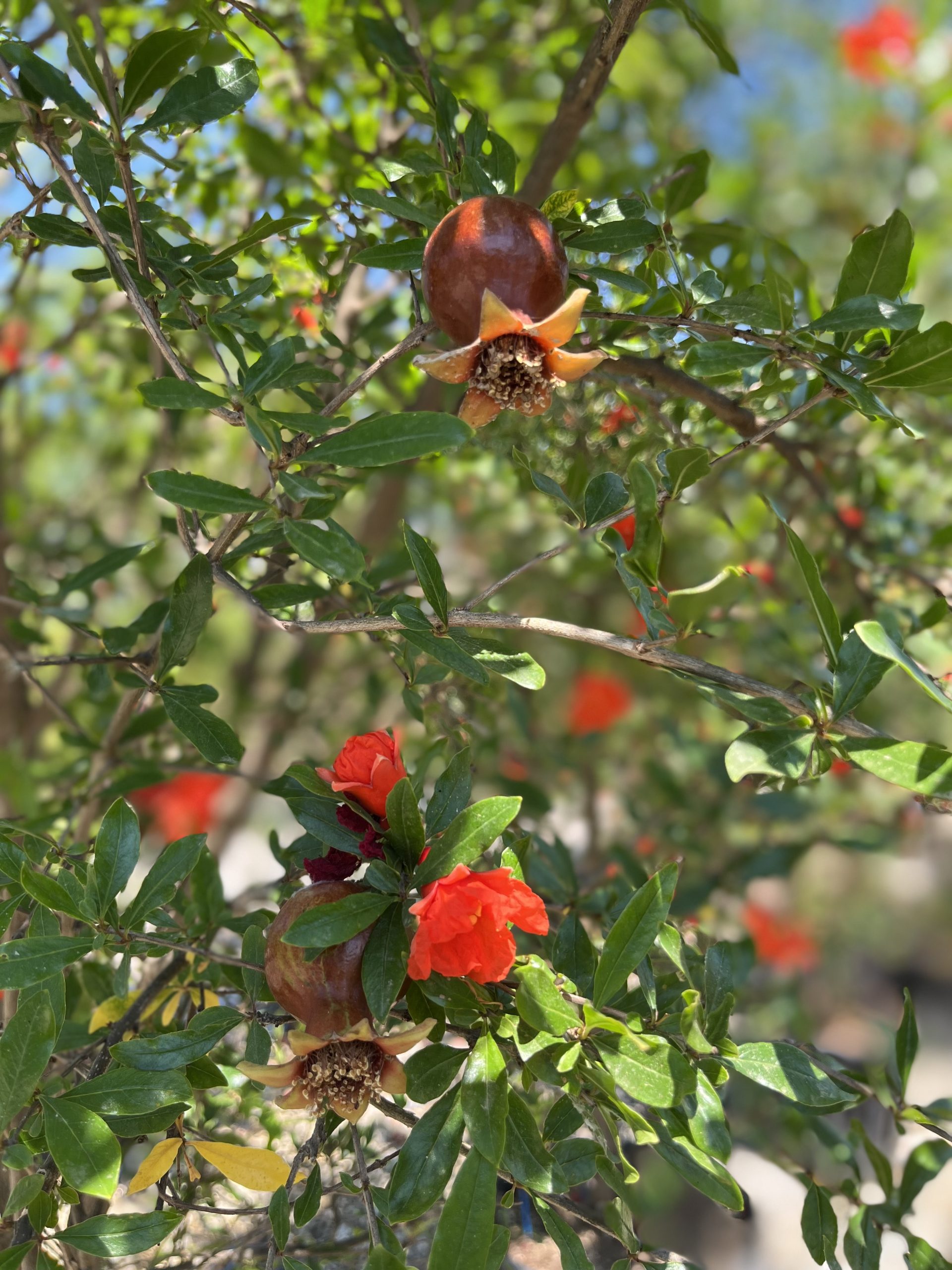
Punica granatum is a plant native to the regions of southwestern Asia, which has gradually spread throughout the Mediterranean basin, becoming an iconic element in temperate and hot-arid climate gardens.
It appears as a deciduous shrub or small tree of medium size, which, when fully grown, can reach a height of 3–5 meters. Its growth habit is generally spreading, with dense branching, especially in young specimens.
The leaves are simple, opposite or arranged in whorls, lanceolate or elliptical in shape, with entire margins and a smooth surface. During the growing season, they take on a glossy green color, while in autumn they turn warm shades of golden yellow before falling.
Between late spring and early summer, the pomegranate is covered with spectacular bell-shaped flowers, in shades of orange-red. The flowers can be solitary or clustered in small groups and are highly ornamental.
The fruit, called a pomegranate, begins to ripen between September and November. It is a globose berry with a leathery rind, ranging in color from yellowish-red to deep red, and has a sweet-tart flavor. The fruits, in addition to being edible, have strong decorative value.
Punica granatum prefers full sun exposure and adapts to a wide variety of soils, including poor or calcareous ones, as long as they are well-drained. It is sensitive to waterlogging, which can cause root rot, but it tolerates drought well. In winter, it can withstand temperatures down to –10 °C , although late frosts may damage young shoots or early flowers. The pomegranate requires minimal care: light pruning at the end of winter to maintain shape and stimulate production is sufficient.
→ Discover Hibiscus syriacus, a shrub with spectacular summer flowering, resistant to heat
Fill out the form below and we’ll get back to you within 24 hours.